

Last Updated: October 25, 2026
Quick Summary
To explain military humor to civilians, start by acknowledging the shared experiences they're missing, the training, chain of command, and unique stressors that make military jokes work. Then provide just enough context to help them understand the situation, letting the absurdity speak for itself rather than over-explaining the punchline.
- Military humor stems from shared hardship and inside jokes that civilians haven't experienced, creating a gap in understanding.
- Translate military slang by giving context first, then showing examples rather than defining terms clinically.
- Dark military humor is a coping mechanism for stress, not callousness, frame it as a tool for managing difficult situations.
- Match your audience: shared-experience humor works broadly, while combat or trauma humor requires careful judgment about who you're talking to.
- Share stories attached to jokes rather than punchlines alone, which helps civilians understand context and makes the humor feel authentic.
Table of Contents
- Why Military Humor Is Different From Civilian Humor
- Understanding the Shared Experience Behind Military Jokes for Civilians
- How to Explain Military Slang Without Killing the Joke
- Military Humor Examples That Translate Across Cultures
- Reading Your Audience: When to Share and When to Hold Back
- Military Humor Explained: Dark Humor and Coping With Stress
- What to Do When a Military Joke Doesn't Land
- Sharing Your Military Story With Confidence
- Frequently Asked Questions
Why Military Humor Is Different From Civilian Humor
Military humor exists in a world civilians don't always understand. It's built on shared hardship, inside jokes, and the kind of stress that only people who've lived it truly grasp. When a veteran laughs at something a civilian finds dark or confusing, there's usually a reason, and it's not just about being tough.
The difference runs deeper than jokes. Military humor reflects a culture where rank matters, where orders come without question, and where the stakes can be genuinely high. A joke about a drill sergeant or a supply chain failure hits differently when you've actually lived it. Civilians hear the words.
This is where the challenge begins. Veterans often carry humor that feels natural to them but lands flat or even offends people who haven't served. The gap isn't about being funny or not funny. It's about context, shared experience, and the specific language of military life.
Understanding the Shared Experience Behind Military Jokes for Civilians
Every military branch has its own culture. The Army's barracks humor differs from Navy shipboard jokes. Air Force culture produces different references than Marine Corps traditions. When you explain military humor to civilians, you're really translating an entire world of shared experience into terms they can grasp.
The core of military humor is this: it comes from people who've endured the same training, followed the same chain of command, and lived under the same rules.
To explain military humor effectively, start by acknowledging what civilians are missing. They haven't worn the uniform. They haven't answered to a drill sergeant. They haven't experienced the strange mix of boredom and intensity that defines military service.
Here's the key: shared experience doesn't just make jokes funny. It makes them possible. A joke about military life assumes you already know what military life feels like. Without that foundation, the joke becomes a riddle.
How to Explain Military Slang Without Killing the Joke
Military slang is its own language. Terms like "Charlie Foxtrot," "hurry up and wait," and "embrace the suck" carry weight because they're shorthand for real situations. When you explain military slang to civilians, you have a choice: explain it clinically, or explain it in a way that preserves the humor.
The trick is to translate without over-explaining. A Charlie Foxtrot isn't just a cluster. It's a specific kind of chaos where everything goes wrong because of poor planning or bad communication. The phrase itself is funny because it's a military way of saying something crude without actually saying it.
Here's how to do it right:
- Give context first. "In the military, we have this term for when everything falls apart at once..." Then introduce the term.
- Show, don't define. "When the supply truck breaks down, the unit runs out of ammunition, and the commanding officer hasn't briefed anyone on the new mission, that's a Charlie Foxtrot."
- Let the civilian figure out the wordplay. Most military slang works because it's clever. Once a civilian understands what the term means, they usually get why it's funny on their own.
- Use it naturally in conversation. Don't announce the term like you're teaching a class. Drop it into a story, then let the civilian ask if they don't understand.
The worst mistake is over-explaining. If you have to spell out every layer of a joke, it stops being funny. The goal is to give civilians just enough context to understand what happened, then let them laugh at the absurdity of the situation itself.
Military Humor Examples That Translate Across Cultures
Some military humor crosses over naturally because it's rooted in universal human experiences: frustration with authority, the absurdity of rules, the bond between people who've suffered together.
"Lighten up, Francis." This line from the movie Stripes has become iconic military humor because it captures something real: the moment when someone is overthinking a situation and needs to step back. You can wear this attitude on a shirt like the Lighten up Francis tee, and both veterans and civilians will understand the reference to that moment of letting go.

"Is this a jelly doughnut?" This Full Metal Jacket reference works because it's absurd. In the movie, a drill sergeant is berating a recruit over a pastry. You can find this joke on apparel like the Is This A Jelly Doughnut shirt, and it works as a conversation starter because people recognize the reference or the absurdity immediately.

The common thread in all these examples: they work because they're about something universal (frustration, absurdity, disappointment) wrapped in military context. When you explain military humor to civilians, focus on that universal core. The military details are just the seasoning.
Reading Your Audience: When to Share and When to Hold Back
Not every military joke works for every crowd. Part of explaining military humor to civilians is knowing when to share and when to stay quiet.
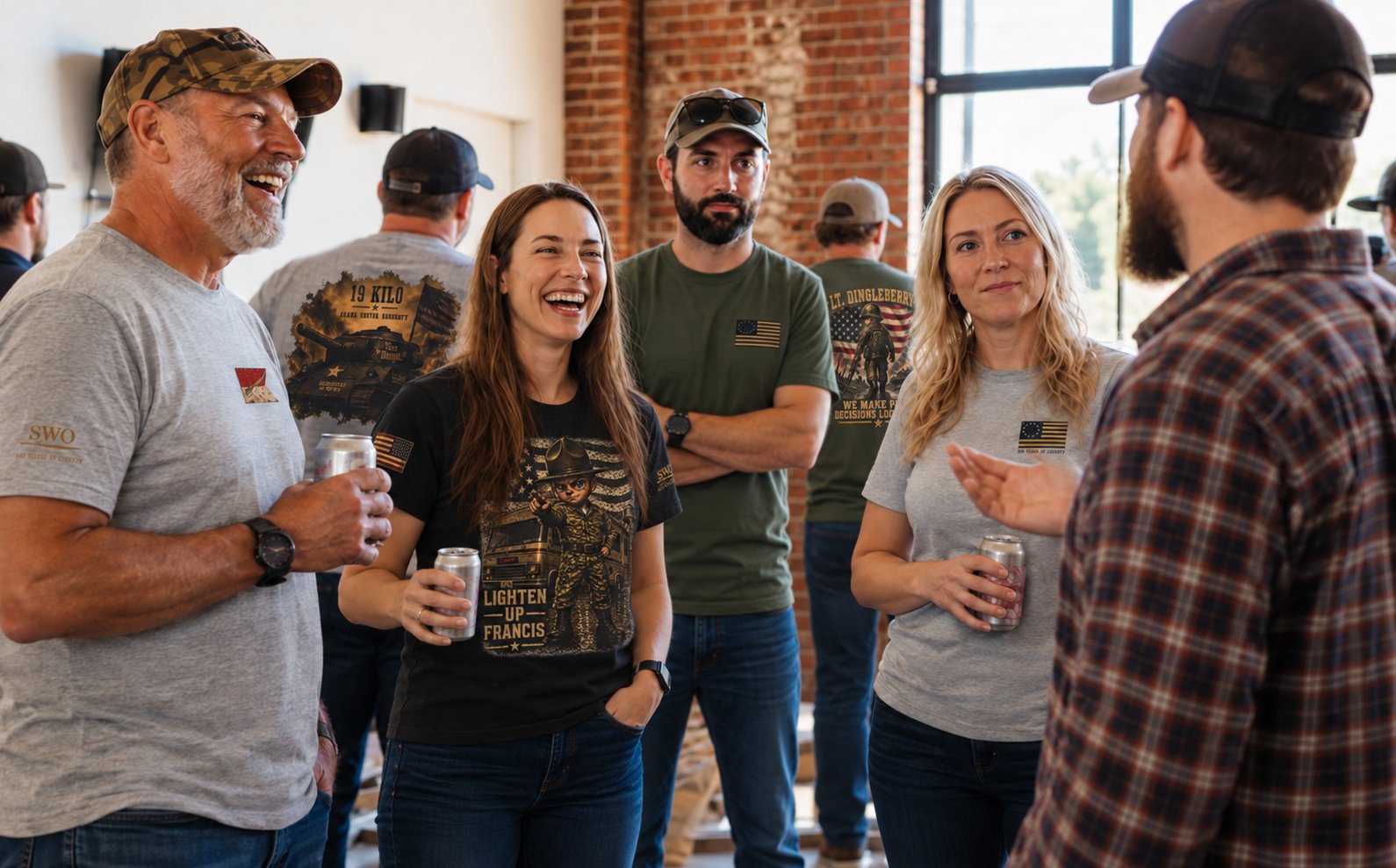
The first rule: know who you're talking to. Are they military-adjacent (family members, close friends of veterans)? Are they genuinely curious about military culture?
Military humor often includes dark elements. It can reference injury, death, or trauma. Civilians who haven't experienced combat or loss might find this shocking rather than funny.
Here's a practical filter:
- Shared-experience humor (barracks food, drill sergeants, bureaucracy) works with almost any audience because civilians can imagine those situations.
- Branch-specific humor (Navy traditions, Army rank structure) works best with people who've served or have military family.
- Combat or trauma humor requires careful judgment. Only share with people who've either served or explicitly shown they understand military culture.
- Self-deprecating humor usually lands well because it shows you're not taking yourself too seriously.
When in doubt, test the waters with a lighter joke first. Watch the reaction. If people laugh and ask questions, you can go deeper. If they seem uncomfortable, pivot to something else.
Military humor falls into categories that work differently depending on who you're talking to.
Humor Type |
Best Audience |
Key Consideration |
|---|---|---|
Shared-experience humor |
Almost any audience |
Civilians can imagine barracks, drill sergeants, bureaucracy |
Branch-specific humor |
Military-adjacent people |
Works best with those who served or have military family |
Combat or trauma humor |
Careful judgment required |
Only share with those who've served or understand military culture |
Self-deprecating humor |
General audience |
Usually lands well, shows you're not too serious |
Military Humor Explained: Dark Humor and Coping With Stress
Military humor is often dark. This isn't because veterans are morbid. It's because dark humor is a survival mechanism.
Civilians sometimes misinterpret this. They hear a dark joke and think the veteran is being callous or disturbed. In reality, the joke is a pressure valve. It's a way to acknowledge something scary or painful without being crushed by it.
When you explain military humor to civilians, this context matters.
The key is to frame dark humor as what it is: a tool for managing stress. You can say something like, "In the military, when things get really intense, we joke about it. It's not that we don't care.
Some military humor references hardship or loss directly. If you're sharing this kind of joke, a simple acknowledgment helps: "This joke comes from a real place.
What to Do When a Military Joke Doesn't Land
Sometimes you explain military humor to civilians and it just falls flat. The joke doesn't land. People look confused. Someone asks a question that shows they completely missed the point. This happens. Here's how to handle it.
First, don't apologize for the joke. Apologizing signals that you think the joke was wrong or inappropriate, which undermines the whole point. Instead, stay calm and either move on or briefly clarify.
If someone asks what the joke means, you have two options:
- Keep it light. "It's a military thing. You had to be there." This acknowledges the gap without making it weird.
- Explain quickly. Give the context in one or two sentences, then move on. Don't turn it into a lecture.
If someone seems genuinely offended, take that seriously. Ask what bothered them. Sometimes a joke lands wrong because of how it was delivered, not because of the joke itself. Other times, the joke touches on something real for that person. Listen, acknowledge, and adjust.
The most important thing: don't let one failed joke make you stop sharing. Military humor is part of your experience. Civilians who care about you want to understand that experience better.
Sharing Your Military Story With Confidence
When you explain military humor to civilians, you're not just telling jokes. You're sharing a piece of your story. That takes confidence, and it's worth doing well.
Start with the assumption that people want to understand. Most civilians are curious about military culture. They might not get every reference, but they're usually open to learning.
Share stories, not just punchlines. Military humor works best when it's attached to a real situation.
Use humor to build connection, not distance. The goal isn't to make civilians feel like outsiders. It's to invite them into your world a little bit.
Wear your experience proudly. Apparel from Say When Outfitters like the Lighten Up Francis - Square Magnet lets you share your humor without having to explain it every time.

The confidence comes from knowing your story matters. Military humor isn't frivolous. It's how you've processed your experience, built bonds with others, and kept yourself sane in difficult situations.
Explaining military humor to civilians bridges two worlds. It takes patience, good judgment about your audience, and the confidence to share your experience authentically. The jokes matter less than the connection they create.
Frequently Asked Questions
What makes military humor so different that civilians struggle to understand it?
Military humor stems from shared experiences—deployments, chain of command dynamics, barracks life, and the stress of service—that civilians haven't lived through. It often relies on jargon, acronyms, and references to military routines that outsiders don't recognize. The humor also frequently uses dark or gallows humor as a coping mechanism for hardship, which can feel jarring to those without that context. Understanding these roots helps you bridge the gap when explaining a joke to someone who hasn't served.
How do you explain military slang without making the joke awkward?
Keep explanations brief and conversational—don't lecture. For example, if you reference 'Charlie Foxtrot' (military phonetic for CF), you might say casually, 'That's military speak for a total mess.' Deliver the translation as part of the setup, not as an afterthought. The key is confidence: if you explain it matter-of-factly, the civilian audience accepts the context and moves forward. Practice saying it naturally so it feels like part of the story, not a pause to define terms.
When should you explain the context behind a military joke?
Explain context before or during the joke, never after. If the punchline depends on understanding rank, deployment, or barracks culture, weave that detail into your setup. For instance, 'When you're a junior enlisted soldier and the sergeant tells you to do something impossible...' establishes the scenario upfront. If you wait until after the joke to explain, the humor is lost and the explanation feels forced. Read the room: if your audience leans in with interest, they're ready for the setup. If they look confused, add context proactively.
How can you tell if a military joke might make someone uncomfortable?
Consider the subject matter and your audience's relationship to it. Dark humor about combat, trauma, or loss can hit hard for civilians who lost loved ones in service or have PTSD in their family. If a joke hinges on making fun of a particular branch, rank, or role, ask yourself whether anyone present might take offense. The safest approach: know your audience's background, avoid jokes about sensitive personal experiences, and skip humor that punches down at specific groups. When in doubt, choose lighter military humor—like the 'Lighten Up, Francis' reference from the movie Stripes—that relies on attitude rather than trauma.


