

Table of Contents
- Why Do Patriotic Shirts Shrink? The Real Causes
- Cotton, Blends, and How Much Cotton Shrinks in the Wash
- Washing Machine Temperature, Agitation, and Dryer Heat
- Pre-Shrunk Fabric and Residual Shrinkage Explained
- How to Keep Shirts From Shrinking: A Wash-and-Dry Routine
- How to Wash Graphic Tees Without Shrinking the Print
- Can You Unshrink a Cotton Shirt? What Actually Works
- Conclusion
- Frequently Asked Questions
Last Updated: October 17, 2026
Why Do Patriotic Shirts Shrink? The Real Causes
Patriotic shirts shrink for one main reason: heat and movement break down the fibers in the fabric, and the shirt never fully returns to its original size. The good news is that shrinkage follows predictable rules. Once you know them, you can stop most of the damage.
Below, we'll show you exactly what happens inside the wash, which fabrics lose the most ground, and how to build a laundry routine that protects both the fabric and the printed design.
How Fabric Fibers Respond to Moisture and Heat
Shrinkage is the permanent loss of fabric dimensions caused by fiber relaxation, mechanical stress, and heat. Three forces work together in your washer and dryer:
- Water swells cotton fibers, then lets them relax and pull tighter as they dry
- Agitation stretches and twists fibers, and they don't spring back evenly
- Heat locks the new, smaller shape into place
Natural fibers like cotton react most. Synthetic fibers like polyester resist water and hold their shape better. That difference explains why a 100% cotton tee and a poly blend of the same cut age so differently.
Cotton, Blends, and How Much Cotton Shrinks in the Wash
100% cotton shrinks the most of any common shirt fabric, and the first wash is usually the worst. The mechanism is simple: cotton fibers swell with water, relax under agitation, and then contract as they dry, and heat locks the smaller dimensions in place. Expect the biggest change in length before the shirt settles into its final size. Blends behave differently because the polyester portion resists water absorption and holds its shape, leaving the cotton fibers less room to contract.
The table below gives practical expectations by fiber content. Treat the ranges as typical patterns, not guarantees, construction, yarn size, and how the fabric was finished all shift the outcome.
Fabric |
Shrink Risk |
Typical Behavior |
Best For |
|---|---|---|---|
100% cotton |
High |
Most movement in the first wash, then gradual settling over the next few cycles |
Everyday tees where you want a broken-in feel |
Cotton/poly blend (roughly 60/40 or 50/50) |
Moderate |
Less pull, better shape retention, slower change over time |
Shirts you want to keep their cut |
100% polyester |
Low |
Minimal change; may stretch rather than shrink with heat |
Performance and moisture-wicking styles |
Tri-blend (cotton/poly/rayon) |
Low to moderate |
Soft drape, modest shrinkage, rayon adds stretch risk |
Soft, vintage-feel tees |
Fiber content is only half the story. Garment type matters just as much:
- Tees, the thinnest knits move the most. A lightweight 100% cotton tee can lose noticeable length in one hot wash; a heavyweight cotton tee resists more because the denser knit has more structure.
- Hoodies and sweatshirts, heavier fleece and loopback fabrics shrink less per wash but can still tighten in the body and sleeves over the first several cycles. Ribbed cuffs and hems are usually the first places you notice it.
- Polos and button-downs, woven cotton fabrics shrink differently from knits. They tend to contract more uniformly, which shows up as shorter sleeves and a tighter chest rather than a shorter body.
- Printed tees, the fabric shrinks, but the print does not, which is why graphics can look distorted even when the shirt body fits fine. That's covered in the printed-shirt section below.
Heavier cotton knits tend to hold their shape better than thin ones. Thicker fabric has more structure to resist the pull.
Washing Machine Temperature, Agitation, and Dryer Heat
Hot water and a hot dryer do more damage than everything else combined. Heat relaxes cotton fibers, and the tumbling action pulls them tighter. A hot dryer then bakes that new shape in.
Agitation matters too. A long, vigorous cycle works fibers harder than a short, gentle one. Front-loading machines generally treat fabric more kindly than aggressive top-loaders.
So what should you do?
- Wash in cold water whenever the label allows
- Choose a gentle or normal cycle over heavy duty
- Skip the extra rinse and high spin settings
- Air-dry when you can, or use low heat
Pre-Shrunk Fabric and Residual Shrinkage Explained
Pre-shrunk fabric has been washed or treated at the mill to remove most of its initial shrinkage before it's cut and sewn. That's why a pre-shrunk tee feels close to its final size on day one.
But pre-shrunk doesn't mean shrink-proof. Residual shrinkage is the small amount of contraction still left in the fabric after that treatment. Most garments carry a little, and it shows up gradually over the first several washes.
The takeaway: even a well-made shirt may tighten slightly. Treat every cotton tee as if it has a little shrinkage left in it, and you'll keep it fitting right for years.
How to Keep Shirts From Shrinking: A Wash-and-Dry Routine
A simple routine prevents most shrinkage. Here's the wash-and-dry process we'd use on any heavyweight graphic tee:
- Turn the shirt inside out to protect the print
- Wash cold on a gentle cycle with like colors
- Use mild detergent and skip fabric softener
- Skip the high spin and remove the shirt promptly
- Air-dry or tumble low, then hang while slightly damp
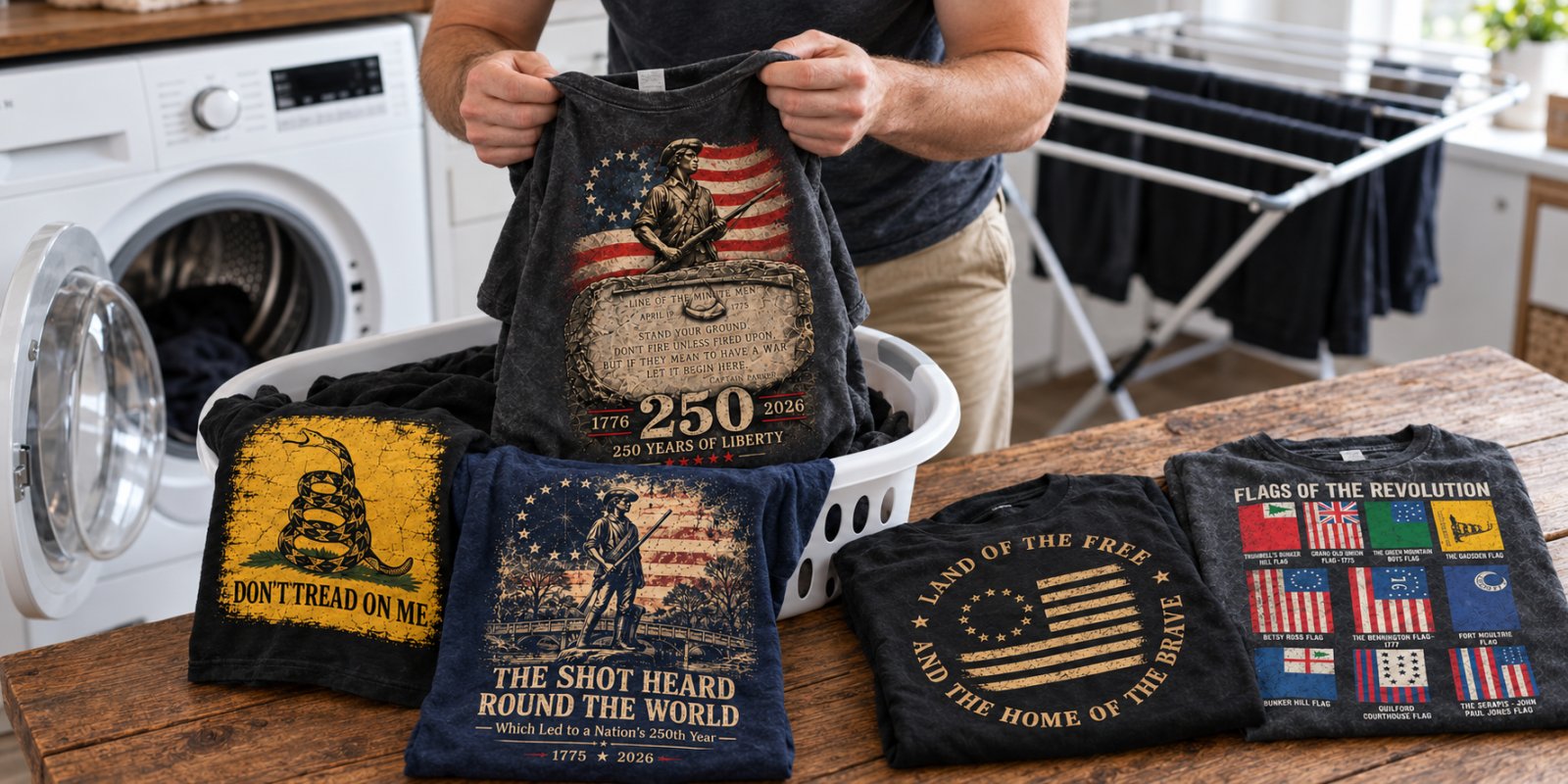
A person in a laundry room sorting heavyweight graphic tees into a cold-water wash load, with a care label visible on one shirt and a drying rack in the background
Line drying and flat drying both work well. If you must use the dryer, low heat and a short cycle are far safer than high heat.
How to Wash Graphic Tees Without Shrinking the Print
Printed shirts need extra care because the design can distort even when the fabric holds. A flag graphic or a bold chest print sits on top of the knit, and heat plus friction can crack, fade, or warp it. The tricky part is that three different things can go wrong at once, the fabric can shrink, the print can crack or peel, and the seams can pucker, and each has a different cause and a different fix.
Separate fabric shrinkage from print and seam distortion
Before you blame the wash cycle, figure out what actually changed. A simple before-and-after measurement tells you more than a visual check:
- Lay the shirt flat and smooth on a table.
- Measure pit-to-pit across the chest and collar-to-hem down the center back. Write both numbers down.
- Wash and dry as usual, then measure again the same way.
- Compare. A shorter collar-to-hem with the same pit-to-pit points to length shrinkage in the knit. A narrower pit-to-pit with the same length points to width shrinkage. If both numbers hold but the shirt feels tighter, the change is likely in how the seams or the print pulled, not the fabric itself.
A few patterns are worth knowing:
- Fabric shrinkage shows up as a uniform change in the measurements. The knit contracted evenly.
- Print distortion shows up as a graphic that looks stretched, cracked, or misaligned relative to the seams, even when the shirt measures the same. Heat and friction attacked the ink, not the fabric.
- Seam puckering shows up as wavy stitching along the shoulders, sides, or hem. It usually means the seam thread and the fabric shrank at different rates.
Wash and dry rules for printed shirts
Once you know what you're protecting, the routine is straightforward:
- Always turn the shirt inside out before washing
- Wash cold on a gentle cycle with like colors
- Use mild detergent and skip fabric softener, which can leave residue on the ink
- Avoid bleach and harsh stain treatments on the graphic
- Skip the high spin and remove the shirt promptly
- Air-dry when you can, or tumble on low heat
- Never iron directly over the print
Washing graphic tees inside out protects the print from rubbing against other clothes. Air-drying keeps heat away from the ink. Together, these two habits preserve both the fit and the artwork.
This is where quality blanks and printing show their value. A heavyweight tee with a properly cured print can withstand more wash cycles than a thin shirt with a heat-pressed design. If a print starts cracking after a handful of washes, the problem is usually the ink and the cure, not your laundry routine.
Can You Unshrink a Cotton Shirt? What Actually Works
You can sometimes relax a shrunken cotton shirt, but you can't fully reverse the change. The fiber has physically tightened, and no trick restores it to the original size.
What helps a little:
- Soak the shirt in cool water with a mild conditioner
- Gently stretch it back to shape while damp
- Lay it flat to dry in the shape you want
What doesn't work: hot water, high heat, or aggressive pulling. These make the problem worse.
The honest answer is that prevention beats recovery every time. A shirt that's washed cold and air-dried rarely needs rescuing.
Conclusion
Shrinkage comes down to fiber, heat, and motion, and every cotton shirt carries some risk. The fix is a laundry routine you can repeat: cold water, gentle cycles, and air-drying. That's how you protect both the fit and the print.
At Say When Outfitters, we build our American-inspired tees on heavyweight Comfort Color blanks for exactly this reason: durable gear built for real life, designed to hold its shape through real wash cycles. Shop our collection and find a shirt made to keep up with you.
Frequently Asked Questions
Do shirts keep shrinking after every wash?
Most of a shirt's shrinkage happens in the first few washes, especially with cotton. After that, the fabric settles and further shrinking is minimal if you wash cold and dry low. Pre-shrunk fabrics lose most of their residual shrinkage up front, so a quality tee holds its fit longer. Hot water and high dryer heat restart the process, which is why a shirt that fit well can tighten up again after a single careless load.
Does a shirt shrink more in hot water or in the dryer?
Both contribute, but the dryer usually does more damage. Hot water relaxes cotton fibers and agitation pulls them tighter, while high dryer heat locks that contraction in and can shrink a shirt further. Cold water plus low tumble or air-drying keeps fabric dimensions stable. If you must choose one setting to change, lower the dryer heat first, since sustained heat does the most lasting harm to fit and to printed designs.
Can you unshrink a cotton shirt that has already shrunk?
Partially, yes. Soak the shirt in cool water with a small amount of mild detergent, gently stretch it back to shape while damp, and lay it flat to dry. This relaxes fibers and can recover some length and width, though it will not restore a shirt that has been repeatedly washed hot. It works best on cotton and cotton blends and should be done before the fabric has been heat-set by multiple dryer cycles.
How can I keep a graphic T-shirt from shrinking?
Turn the shirt inside out, wash in cold water on a gentle cycle, and skip the high-heat dryer. Lay it flat or hang it to dry, and avoid ironing directly over the printed design. Washing graphic tees inside out protects the print from abrasion, and cold water limits the fiber contraction that causes shrinkage. Airtight habits matter more than any single product: consistent cold washing and low-heat drying keep both the fit and the design intact.
Have a shirt that's already tightened up? Start with the cold-water soak above, then switch your routine for good. Browse the Say When Outfitters collection to find heavyweight tees built to last.


